When The Real Becomes Optional
Living in an Age of Simulation
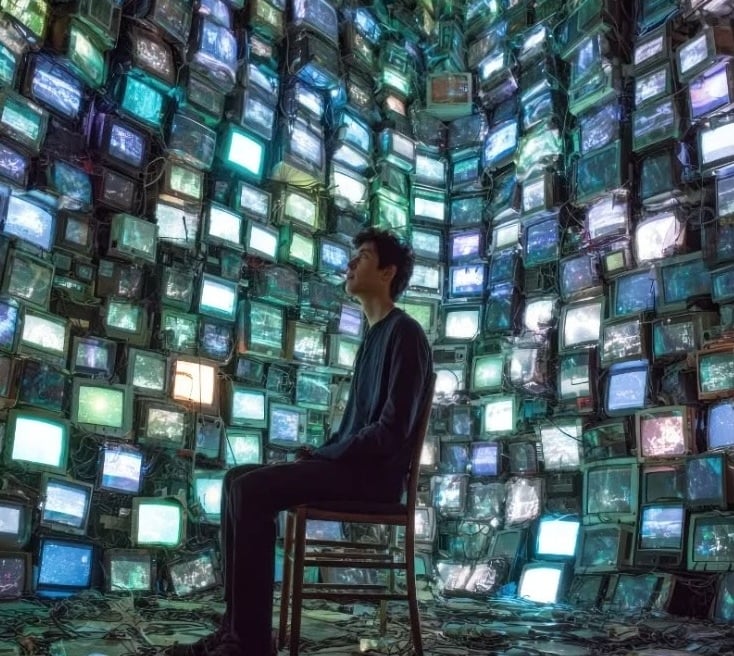
Reality. What is reality? That question has been explored from countless perspectives by philosophers, scientists, mystics, and artists throughout history. Reality itself is one of the most fascinating subjects of inquiry. The word reality points us toward the real, that which relates to things as they are.
I have always been fascinated by reality. Why are we here? Where do we come from? Where are we going? What is this place we call life? These questions have shaped me into an observer of reality, participating in life in order to understand it. As such, I have never taken much for granted. I have always questioned assumptions, systems, and the different workings of this world.
What I notice today is an increasing disconnect from what is real.
In the Western world, technological advancement is widely celebrated as progress. Yet alongside extraordinary innovation, I also see increasing social fragmentation and ecological decline. As artificial intelligence becomes woven into every aspect of our lives, I cannot help but wonder whether this disconnect will continue to grow.
Today, AI allows us to create almost anything: flawless images, polished versions of ourselves, perfectly written messages, impeccable voices, and entire digital identities. In business, there is growing excitement around building AI agents that work on our behalf and avatars that represent us better than we represent ourselves.
As someone with perfectionist tendencies, I understand the appeal. I have spent years trying to get the details right. Yet I have also learned that perfection is like the horizon: you can keep walking toward it, but you never quite arrive. Ironically, AI now delivers what appears to be perfection.
But something has caught my attention. I find myself missing the imperfections that make us human. It makes me reconsider the meaning of perfection itself. But most of all, I am missing resonance. When I encounter AI-generated avatars or videos, I feel an emptiness. That feeling intrigues me. To me, this emptiness indicates an absence of connection.
The words may be flawless. The visuals may be stunning. The voice may be impeccable. Yet nothing in me resonates. I don’t feel touched or moved. In fact, I don’t feel anything. I simply can’t relate.
With another human being (even online), something subtle happens. There is contact. There is presence. There is an invisible field. Something alive passes between us. You can feel the air change through the quality of presence and communication.
I feel engaged when real people tell real stories about real experiences. There is life moving between us: an energy that circulates, reactions are evoked, there is room for spontaneity, emotions, and sensations. It has texture, a perfume, an essence. It’s alive.
Watching AI-generated humans does not have the same impact. That subtle energy is missing. It feels devoid of life.
In our pursuit of improvement, we seem to be replacing our living nature with artificial substitutes.
Ice cream offers a simple analogy. Artificial flavouring never quite tastes like ice cream made from real fruit. It imitates, but it does not carry the richness and complexity of the original.
I wonder whether we are doing something similar with our lives. What happens if we gradually replace the natural with the artificial in everything?
As I imagine this future, I feel no sense of wonder or awe. Instead, I feel depleted, almost as though I have stepped into a nightmare. Except I am not dreaming. I see it unfolding around me.
We may be living under a technological illusion: the belief that artificiality can satisfy the deepest parts of our humanity. But I doubt that it can.
I am not arguing that AI is bad or that simulations are wrong. I believe they can offer extraordinary possibilities. Used wisely, they can amplify creativity, solve meaningful problems, relieve people of repetitive work.
But every technology also shapes the culture that uses it. Social media offers a useful example.
Its original promise was to connect friends, families, and communities across the world. Yet over time, it became increasingly driven by algorithms, advertising, manipulation, polarisation, distraction, and, dare I say, even addiction. It is no longer serving the purpose it originally set out to fulfil. Quite the opposite, it has moved from connection to disconnection.
What happens when AI is increasingly used to generate our identities, false promises, or simulate connection and intimacy?
I may simply be a romantic. But I feel that something is off. Or perhaps I just prefer real fruit in my ice cream. I know I yearn to deepen my experience of existence and feel the vibrancy of life deep in my bones. Listening to real music played by a real human being, conveying a real message born from his or her own experience of reality. That realness touches something in me that no simulation comes close to.
I have been to those grand immersive virtual reality experiences. Yes, they are impressive. But I have never felt as replenished as I do when I am immersed in nature, in the mountains, or by the ocean. Nature breathes life into me. Virtual reality drains me. A real conversation regenerates me. An avatar does not move me.
I know that somewhere deep inside most of us lives the question: Am I good enough? This may be the tragedy through which we trade our direct experience of reality for its simulation, hoping it will make us feel good enough.
But what if our lives come to depend more and more on maintaining an artificial version of ourselves in an increasingly artificial society? I suspect many people will eventually break. There is a potential risk of collapse created by the widening gap with reality.
I wish more people could see that our awkwardness, vulnerability, uncertainty, and imperfections are precisely what make us beautiful and unique. One day we may discover that what nourished us was never perfection.
It was the trembling voice telling the truth. The wrinkled hands that had lived. The shared silence between two people. The smell of the forest after rain. The taste of a strawberry warmed by the sun. The laughter that no algorithm could have predicted.
I believe that life expresses itself through relationship. Many philosophers, scientists, and contemplative traditions suggest that reality is not a collection of isolated things, but a web of relationships. If that is true, the question then becomes: does our technological progress deepen and strengthen our web of relationships with ourselves, with others, and with this world?
Because perhaps this is where real progress begins.